Friday, May 4, 2012

What Do Rocks Want?

This little spot in the college's library was my haven for several hours over the past two week-ends, my place to think about stone becoming statue which, really, is what I'd like to be thinking about all the time. I get to go back one last time to finish my Kalamazoo paper and sketch out the places I want to fill out. It seems impossible that there would be time to think now, but I've been killing myself to get the grading done so that I actually have a relatively clean slate this week-end. Which is good, because the rocks want some attention. The central idea of the paper is to ask "how the geological phenomena of alabaster manifested themselves to the medieval sculptor." How characteristics like its porosity (high), hardness (low), and water solubility (surprising) lent themselves to what medieval sculptors wanted to create between 1350 and 1530 (the heyday of alabaster carving). Everything about this paper has been delicious: discovery, fascination, beauty, awe - everything you want in what you'll be writing about. The challenge has been between the social historian in me who is excited to present the detective work that might explain why alabaster's heyday was so specific (the Black Death was a factor in its beginning (not its end), I believe) and the more evocative writer in me (who is mostly tremulous and sometimes maybe occasionally emboldened) who wishes to have my audience revel in the how of alabaster's transformation into St. Sebastian's pierced body or the breath of God. Who can't get over that alabaster hardens when air hits it, that it disintegrates into Plaster of Paris when rain hits it, that the best alabaster is just 2-3 feet below the surface, that the stone is the trace of Permian, Triassic and Jurassic oceans, and that a huge vein of it marks what is known as the Tutbury Seam (which, frankly, I just love to say: Tutbury Seam). I want the evocative writer to win, even though she knows that the audience will be pretty conservative, and even though W.J.T. Mitchell's first foray into image agency (in which the first question from a stunned audience was "Are you serious?") keeps replaying in her head. The evocative writer finds herself very quickly on the defensive (right around paragraph 4), claiming yes, agency for stone, but oh no, not will. I think that geology will help me break free of that - there is plenty to revel in there. And I do think about the audience members then going to see the show of alabasters that will be on display at the Kalamazoo Institute of Arts and hopefully knowing more about the stone before it became a statue, hopefully reveling in thinking through its metamorphosis from stone to statue beyond human agency. That's a good goal. Plus, if I can channel Jeffrey Cohen's elegant lithic courage, all will be well.

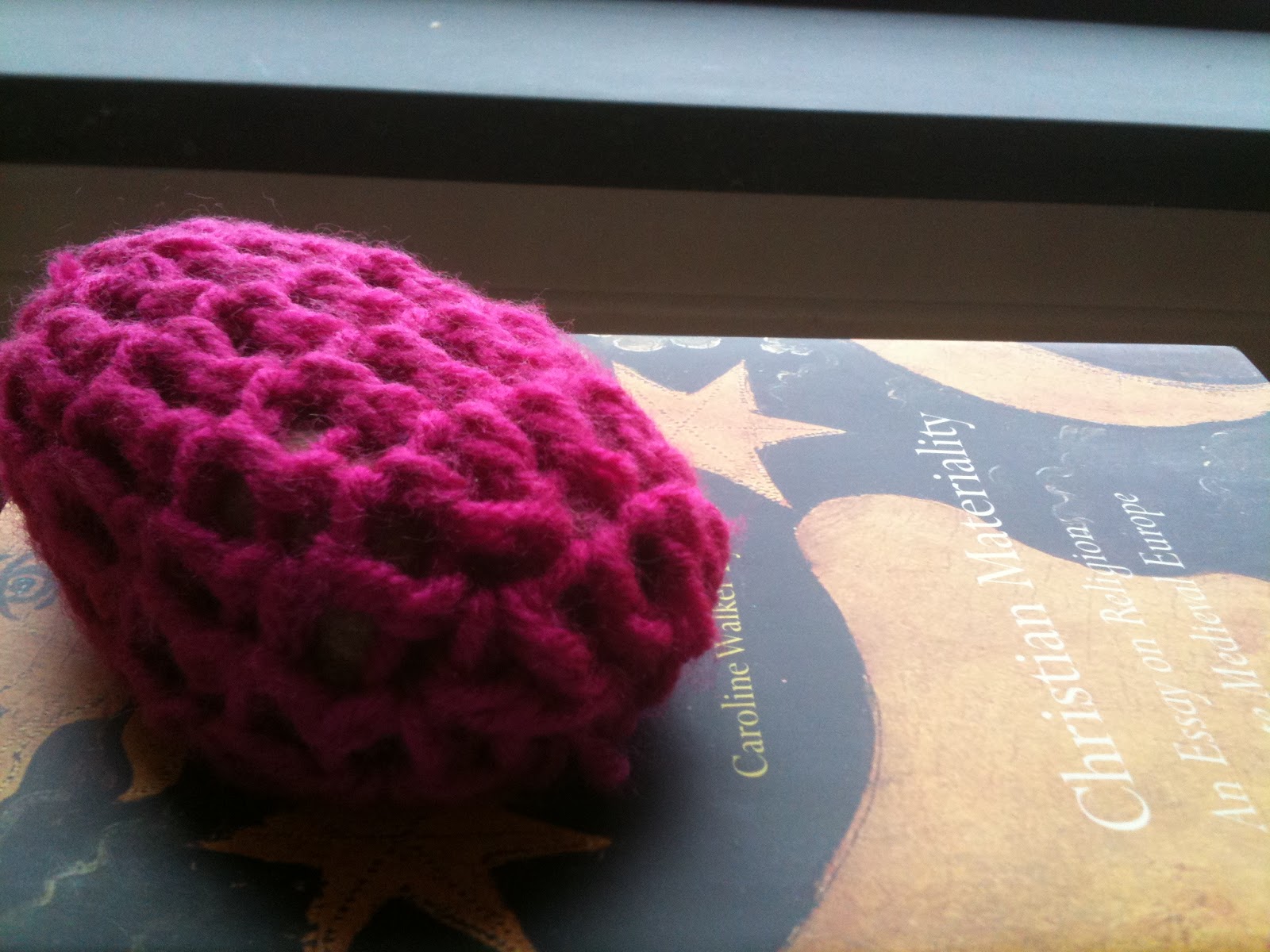
In the meantime, there are many little gifts. In waking up Oliver a couple of weeks ago, I told him excitedly that I was working on a paper trying to figure out what rocks want from us. "When did you become religious?" he asked sleepily. ??? "Why do you ask that?" I asked. "Because only religious people believe inanimate objects want things from us." I'm still thinking through that one. And then Mac giving me a small alabaster vase for Christmas (it's picking up the light in the image above, and yes it's Egyptian alabaster which turns out to be completely different from English, but it's the best gift nonetheless). And lastly, this rock cozy, that some witty soul knitted when we made a Hyperbolic Crochet Corral Reef here on campus for ArtsFest. When Mac was taking it down, he found this cozied rock at the bottom of it. If you're thinking well-tended Pet Rock, go ahead. But I love that this knit surface doesn't slip on and off, that it's for keeps on this rock, that this rock could possibly be warm, or want to be warm. Do I need to tell you of my pleasure in learning that alabaster has a rapid heat capacity?

Tuesday, April 24, 2012

Questing for Prester John in Ethiopia

Prester John in Ethiopia, Genoese Planisphere, 1457
How quickly the map obsession sets in. Tomorrow is our big day with Prester John, and I will have the total thrill of sharing it in a class session to be attended by a Really Big Medievalist who is coming to campus through the invitation of a good friend of his who is one of the coolest and nicest people I know here.  Where we began with Prester John's 12th century letter, when he still "just" ruled the Three Indias, tomorrow, we'll end with the 1520 transcription of his letter to the King of Portugal by Francesco Alvarez, author of The Prester John of the Indies, ambassador and missionary of the King of Portugal, who spent several years at the court of Lebna Dengel in Ethiopia and wrote of him as Prester John. Just mapped all that Prester John goodness right on. There are two massive intertwinings here. The first is history and fantasy.  The fantasy of Prester John, the endless quest of Europeans for this imaginary Christian king is endlessly fascinating.  The history, though, as it can be imagined to fulfill this fantasy, is captivating, too. Particularly the ancestry of Ethiopian kings from Menilek, the child of Solomon and the Queen of Sheba.

Catalan Map, 1450 - Prester John's in blue
The second intertwining is with reading travel writing and finding placenames. I should just let all of the placenames wash over me, some wondrous Uebelian list of marvels. But I find myself wanting to find the place names of the maps, both medieval and modern. In case you're wondering, the medieval maps are harder. Aside from having to sidestep the occasional giraffe or Blemmyae, the placenames themselves are completely different.  Googlemaps makes searching modern maps a total thrill.  There are intelligent things to say about the globalizing perspective that GoogleMaps offers the armchair traveler, but I don't have them in my head (I bet that Mandeville would have loved GoogeMaps, though).  But there are maps....

Hobo-Dyer Equal Area Projection Map

.... and there are maps.  Wo-ha, right? This is the Hobo-Dyer Equal Area Projection Map, cousin of the famed Peters Projection Map which turned the Mercator Projection Map (the one we're more familiar with) literally on its head.  The best (I swear) tutorial on this comes from a 3 and a half minute clip of the West Wing (no, really).  There's more to learn, of course.  For now, Holly the cat's extreme hounding prompts me to stop, but just so you know, it's even harder to get to Ethiopia let alone India on this map.

Monday, April 23, 2012

Who's Your Friend?

"Legend and Landscape in Brittany, France"
I don't have the brevity of wit to truly engage in Facebook, but many a day has been brightened by a comment from a Facebook friend, or by thinking about Geoffrey Chaucer's take on Facebook, and so I feel, well, friendly to it. I'm using it to advertise my upcoming eco-criticism Winter Term trip to Brittany (huzzah!), and will use it to post updates and questions, conversations and more as we consolidate our group (24 students thus far, so we are a go) (huzzah! huzzah!). I've also decided to use it for some collaborative writing amongst my students. They are working in groups of 2 or 3 for their "Monsters and Marvels" manifestos (or, as one student said, "Monsterfesto"). Hybrid, collaborative writing of declarative statements bolstered by original sources both visual and textual seemed much more fitting than the classic term paper for this class. The students were initially appalled, but are warming up to the idea - especially, it seems, after I introduced the Facebook assignment. Facebook groups have all of the features that I wanted to encourage collaborative writing: first of all, you can set a group to "Secret," so that the students can work just among themselves. And then: see those tabs at the very top? "About" invites them to collaboratively write how their three monsters interact; "Events" asks them to isolate the (trans)formative events in their monsters' existence; "Photos" is the art history hook; and "Docs" is just that: this lovely simple format space where each can write 750-1000 words by Tuesday at 10 p.m. - the content there is driven by the intersection of the Events and Photos they've chosen. What I like best is that I left the role of "Posts" open and that has proven to be where they're doing their thinking. One group has posted no less than 20 comments today back and forth, exchanging citations, reworking language, directing each other to a cartoon about Host Desecration (!) (from Russell's Teapot, but I can't find it on the web - they're so much savvier than me!). It was a steep learning curve for me, but I love their level of engagement. And I somehow like the idea of their posting comments to each other as part of the working process better than thinking of them isolated staring at 1/1 of a blank Word document (although that, of course, has its value). The one strange thing I do need to register is how we all gain access to each other's work. The students have all had to "Friend" each other, which is fine - they did it without blinking. But I've had to "Friend" (in that Facebook way) all of my students, something I have assiduously avoided doing because I just don't want to know what they're up to on Facebook. No matter, I just won't look - no curiosity, no time. Furthermore, in order to make myself and everyone else comfortable with the whole process, I found myself saying to my entire class, "Once this project is over, I will de-friend all of you." Seems so unfriendly! But we can re-friend (oh my God, the language!) each other on the side, later, after they've graduated. As weird as the language is, I like this idea of a suspended community, gathered together out there in Facebook for the next month, creating hybrid texts, exchanging ideas, and being friends.

P.S. I end every evening I can by reading the latest from the blog In the Middle, a constant source of inspiration. Tonight's is especially wonderful and reveals the exciting and productive reaches of a collaborative academic community of friends, as well as the warmth that Jeffrey Cohen brings to collaborative endeavors.

Thursday, April 19, 2012

Gift

...tulips, roses, daffodiles, poppys and other delitefull smells...
So the session on "Mongols and Missionaries" was difficult (another post), and the grading is nuts, and that proposal to the administration is due, and there were five student meetings, and so no time for class prep and hurtling and hurrying seemed to be the only way. And then a notice that Iris has been selected to read a piece of writing at a "celebration of young authors" at the local library, and so we rush through dinner and make it there and throw ourselves down in some seats and only then did my vision clear. And I saw my actually still pretty small daughter up there with a microphone and a piece of paper, and I realized that I had no idea what was on that piece of paper. We knew from dinner conversation that she'd be working on it and "rewriting, as real authors do" we were told, but I realized that I was about to hear something completely new from her, and already it seemed like a gift.  I've since procured a copy of said original writing, and I'm rewriting it here because it's how Iris sees the world, framed through the memory of a place whose possibilities are only growing. She returns with a narrative ease embellished by new details of her imagination, linking her experience there with her desires for the place. I fling myself and my students hither and yon across medieval imaginary landscapes in pursuit of various medieval pursuits of lost Edens, and now here is an imagined return, very close to home. I've kept her spelling, because it's always cooler than the conventional way.

"I once went to Joslé, a town in France. When I was there I found a walkway near the river that rippled by.  I went down the walk way to explore and have adventure. As I was walking a loud bark came into hearing range. I followed the barck to a gate.  When I looked beyond the gate I could barley make out a bridge.  Then I went home.  A few days later, I found out our host (who was currently in Africa and lending the house) was friends with the man who owned the house. I went there and found where the feroshisly loud barck was coming from: a humongous Great Dane! He infited me in and I liked him right away. After that, I visited quite often and once I asked "What lies beyond the house?" That's when I saw the buitifull garden. It smelled of tulips, roses, daffodiles, poppys, and other delitefull smells.  By the way, the names of the men were David and José, and the dog's name was Dooby. The place was wonderfull and my only dream is to go back there someday."

Monday, April 16, 2012

Fragmentation, Loss, Utopia

Arma Christi, c.1300
Prester John is only visualized when he is racialized.  I've only seen images of him once he is Ethiopian, later in his career within the Western imaginary.  His early days in India, chronicled in the letter from him that emerges in the 1160s, do not seem to have produced portraiture.  And so what's an art historian to do when she really really wants to teach the letter because a) it's awesome (that bed of sapphire!), b) Uebel's book about Prester John, Ecstatic Transformation, is phenomenal, and c) we need to tackle this issue of non-representation as much as that of representation?  The short answer is that instead of teaching images of Prester John, I presented images of the perception that Prester John produces: lists, fragments, discontinuities.  This move was much inspired by Uebel who treats the fragmentary and the discontinuous in his analysis of the insistent listing (of animals, monstrous races, gems, spices, palace furnishing, landscapes, and more) of the letter.  The more I read Uebel, the more I began to think of the "thrill of the fragment" so prevalent in medieval art.  The Arma Christi above are a simple (but thrilling) enough example: this is one of two pages that present the weapons used at Christ's crucifixion in a completely discontinuous framework that thoroughly fragments that narrative of the Crucifixion.  The sponge filled with vinegar that Christ was given to drink stands (lies?) next to the spear that pierces his side; the three nails that will enter his hands and feet are next to the chalice that will catch his blood.

Arma Christi, 15th c.
There are some extreme examples.  Yes, that's Malchus's ear suspended there, and a soldier's spit in mid-air, and that is indeed the wound of Christ now huge stretched out below (on the ground?).  I asked the students to articulate the experience, the process of looking at this image. At first, it was what it was not: it was not narrative, it was not connected, it was not linear.  Then they offered other terms: spaceless, timeless, suspended... in short (or so Uebel helped us see), utopic.  And this is where it got really exciting for me, being able to connect the fragment to utopia through the framework of loss. For what are these images of Arma Christi but a fragmentation of the Crucifixion, the loss of Christ's body and presence? One that must be compensated for in every Eucharistic performance, one that must be (yes) re-membered in every liturgy.

Stavelot Altar, c. 1175
And so the letter of Prester John is born from this dynamic of fragment, loss, and utopia, one that, for Uebel, defines medieval Christianity well beyond the dynamic as it applies to Christ. My students leaped: "Is the loss of the Garden of Eden then responsible for colonialism?"  (For Prester John, a Christian ruler in India descended from the Three Magi, was always already a colonialist - a product of the colonial imagination, conquering wondrous lands shimmering through fragments, promising a return to the West to enrich and protect it).  Colonialism is too righteous and complex a phenomenon to be explained that succinctly, but one does think of the repercussions of a fragment, loss, utopia dynamic.  Especially when we can see it, and imagine its performance.  We ended class with the Stavelot altar, a portable altar (for when you need to take your fragment, loss, utopia dynamic on the road).  Portable altars have always fascinated me: they carry (reduce, condense) much - namely, the entire liturgical and spatial framework of religious architecture. You're supposed to be able to consecrate a host on them, bring forth the body of Christ, recover the loss through the fragment in this utopia. As such, they are mystical (almost magical) objects themselves, containing relics, as the Stavelot altar does, beneath central crystals.

Adelhaus Altar, c. 875
Or presenting an abstract surface, as the Adelhaus altar does, its central space of consecration filled with the formlessness of porphyry - a resonant echo of Prester John's bed of sapphire.

Thursday, April 12, 2012

Beauty, Fantasy, Difference

Bosch, Epiphany, 1500, the Prado
There are more papers, more events, more bureaucracies, more of everything that needs to be swept away for just a few minutes.  Balthasar has been on my mind since Tuesday, when we entered the third theoretical framework of "Monsters and Marvels" - race and ethnicity.  There is much brilliant work on this in history and literary criticism, but medieval art history still produces mostly catalogues of images of race (we debated in class what an image of race was vs. one of ethnicity). What I'm going to be arguing over the next few weeks is that what appears to be an absolute divide of race (black/white) is actually constantly negotiated across ethnic divides of costume, language, gesture, and religion.  What propels the negotiation, the back and forth over identity, is, I think, desire. Desire both for the exoticism of Balthasar's beautiful blackness, and also a desire for that blackness to be taken up into a globalized white Christianity.  Balthasar is at once visibly African but already (always already?) on European Christian terms.  There are photocopied chapters of Desiring Whiteness; a Lacanian Analysis of Race by Kalpana Seshadri-Crooks on my desk that I'm dying to read (maybe, maybe tomorrow).  In the meantime, there is this image of Balthasar with the other two Magi (and a funky Antichrist showing quite a bit of leg, but that's Bosch for you) approaching Christ. (Actually, the funky Antichrist bears much further examination and I've heard Leo Koerner speak on it at Chicago - wonder if it became "Bosch's Enmity" in Tributes in Honor of James H. Murrow. In any case, if Balthasar is black, the Antichrist is whiter than white, and that ghastly wound encased in a glass anklet makes the mind reel. The limit of interpretation with Bosch rears up pretty fast.)

Bosch, Epiphany, 1500, Prado, detail
And this beautiful face - and the viewer's response.  The poise, the gesture, the simultaneous difference within and belonging to the scene.  There is profound knowledge of this face - is it a portrait? It's not too early to ask, even with Bosch.  To me, the beauty of this face is the intimate knowledge of it that the painter provides, that he gives the viewer. We would recognize this man if we saw him. And we are seeing him, he is very present.  This high individuality is then materialized in his gesture around the jar of myrrh, that most African of aromatics (found in Yemen, Somalia, Eretria, and Ethiopia) that he brings to the occasion.  There's always something "wrong" or at least difficult and uncomfortable about "images of race" because the minute you call them that, you are talking about images of (hierarchical) difference, and all the inequalities and oppressions therein. Then again, you can have celebratory images of difference: "It's like a religious Benetton ad," said a student of mine in explaining the racialization of the Magi in late medieval altarpieces. Painting around 1500, did Bosch revel in Balthasar's difference, or is the lavish beauty of Balthasar an aesthetic escape - from difference to beauty? I find these images hard to read.

Bosch, Epiphany, 1500, Prado, detail
I sometimes wonder about the desire solicited by the beauty of these images of Balthasar, or saint Maurice, or the Queen of Sheba.  For these are beautiful bodies beautifully adorned. Let's be clear, as we muddy the waters: there are ugly, exaggerated images of Africans in medieval art, too - look to Debra Higgs Strickland's Saracens, Demons and Jews - but I can't just see those as "bad" and these as "good" images of Africans. I have to think of the work of difference that beautiful images initiate. I made the robes of Balthasar and his attendant big so you could really see them.  It's in that monstrous border that I see work to be done on what I ultimately hope to argue is the ambiguous work of visualizing difference in the late Middle Ages: theirs are the only robes with hybrids monstrosities abounding, theirs the only robes with pearls, theirs the only garments with an excess of fabric that causes the adornment of an incredible sleeve to fall thickly upon the ground. Theirs, too, the only robes with the perfect illusion: the birds pecking at the pearls on the border do so as earnestly as the bird on Balthasar's jar pecks at the pearl on its lid. But now wait, is the bird on Balthasar's jar but a fantasy as well? (The jar itself is a fantasy of another gift, to a god far away? long ago?) And Balthasar? What do we do with this realization that Balthasar's difference is visualized in skin color and in fantasy? Balthasar is different because of his skin color, but also because of these illusions, these fantasy images of pearls, birds, monsters. What is a difference visualized in fantasy? The simultaneity of pleasure (my God, those pearls!) and wary fascination (what is the birdman saying to the birdwoman?) is taken up so wondrously by Michael Uebel in Ecstatic Transformations.  That's tomorrow's reading and I'd best get to it. For tomorrow we meet Prester John for the first time - ultimately we will find his image (in Ethiopia) on maps, but tomorrow, he is still in India, and I think that I'll show European stones and gems as faint glimmers of the Indian gems that Prester John is imagined to rule with, live within, and even sleep upon.  "Our bed is of sapphire," says he, "on account of the stone's virtue in chastity."  Another difference, another fantasy.

Tuesday, April 3, 2012

What Happens When Your Kid Grows Up Without Any Team Sports

Wow! Check out the logo
I have never had the wherewithall or motor skills to follow or participate in team sports and Mac hasn't either (actually, I've never asked him - they never come up). The entire field of medieval studies has always seemed blessedly devoid of team sports intrigue, even with the squirmishes depicted in marginalia between monkey teams and something like duck teams. Consequently, our children's efforts in the world of team sports have been dabbling at best.  There was a Saturday morning soccer season, which consisted mostly of (not joking) chasing butterflies off the field and tracking airplanes overhead; basketball was deemed absurdly tense considering the point (of putting a ball in a basket); and we all know how we all feel about kickball. Oliver probably knows more about Quidditch than any other sport (although his current reading of (gulp) The Hunger Games may change all that). So Saturday night's impromptu viewing of the last 5 minutes of the Ohio State-Kansas game was unprecedented for the little guy and he watched riveted as Ohio State (for whom we were cheering because our friends were, and because they have renowned Women's Studies and African-American Studies programs) lost the grip it had had on the entire game in the last 3 minutes, and then went on to lose it all 64-62, when a beautiful strategy fell prey to what must have been the highest pitch of adrenaline ever.  It was utterly heartbreaking and we got completely caught up in the action and pathos of it all.  We got in the car afterwards, and within the quiet moment after everyone had buckled up and we'd settled in for the ride, Oliver turns to me and says, with a blend of incredulity and exhaustion, "What a revolting turn of events!" This without any benefit of knowing The Life of Riley. This from the kid who brought you hapless cretins.  He was just stunned at the, well, revolting turn of events for the team.  How could such a thing happen?  The unpredictability of it all was unnerving for us both.  Some day I'll know where to put this little anecdote in the annales of parenting (should we have done more team sports? are there life lessons he's missed?) - for now, Oliver has given me another phrase to apply all too liberally to my every day life.